Names (DNS)
Connect prompts name the address: github.com (140.82.112.3:443). With --dns=observe (the default of hallpass), the sandbox's DNS queries go through a forwarder of hallpass's, which reads the answers. On Kubernetes, hallpass-node does the same (see below).
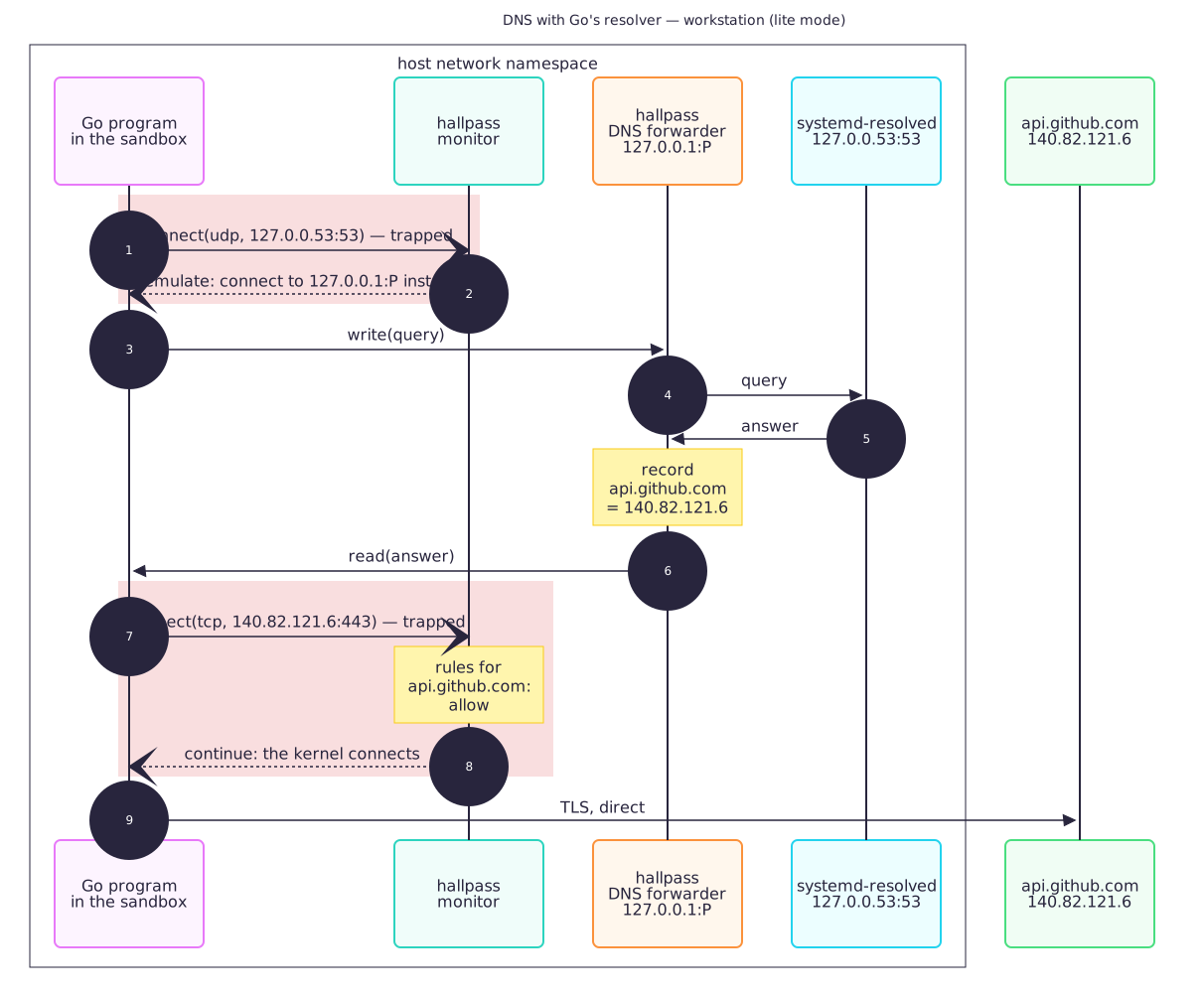
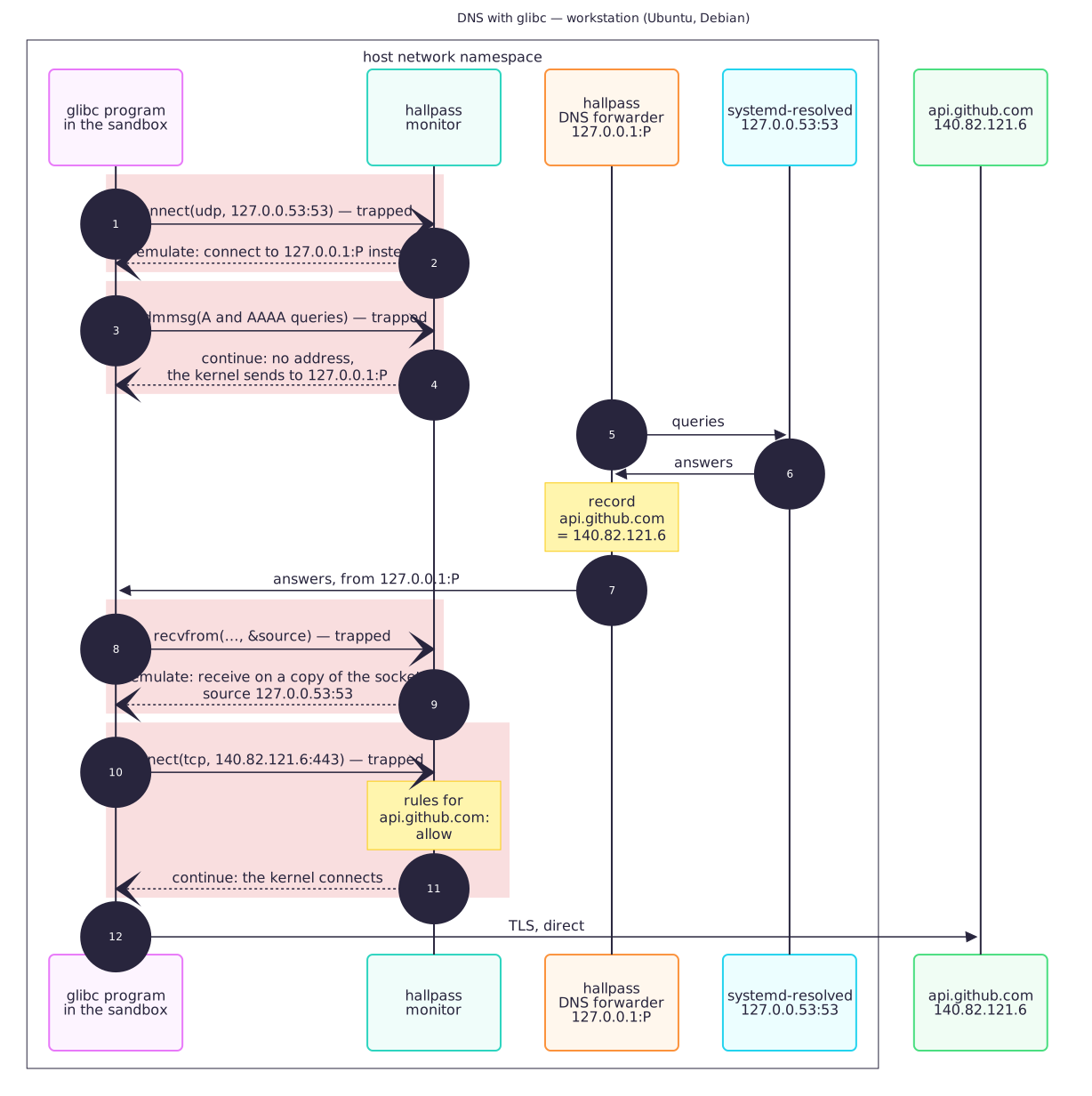
Before the sandbox starts, hallpass starts a forwarder for each name server of /etc/resolv.conf, on a port the kernel picks on 127.0.0.1 (or [::1]). An allowed connect, or UDP sendto with an address, to port 53 of one of those servers is done by the supervisor to the forwarder instead, on a copy of the sandbox's socket (pidfd_getfd: the same socket, whichever descriptor of it the sandbox uses next). On such a socket, a receive that asks for the source (recvfrom with an address, recvmsg) is done by the supervisor too, with the forwarder's address replaced by the server's: resolvers check it. UDP and TCP, connected or not. How each resolver goes through it:
Workstation
Go's resolver connects a UDP socket per query type, then uses write and read, which are not trapped.
glibc connects, sends both queries with one sendmmsg (no address: it continues), and checks the source of each answer with recvfrom. With resolve in nsswitch.conf (Fedora, Arch), glibc asks systemd-resolved's varlink socket instead: see the Go/cgo tab.
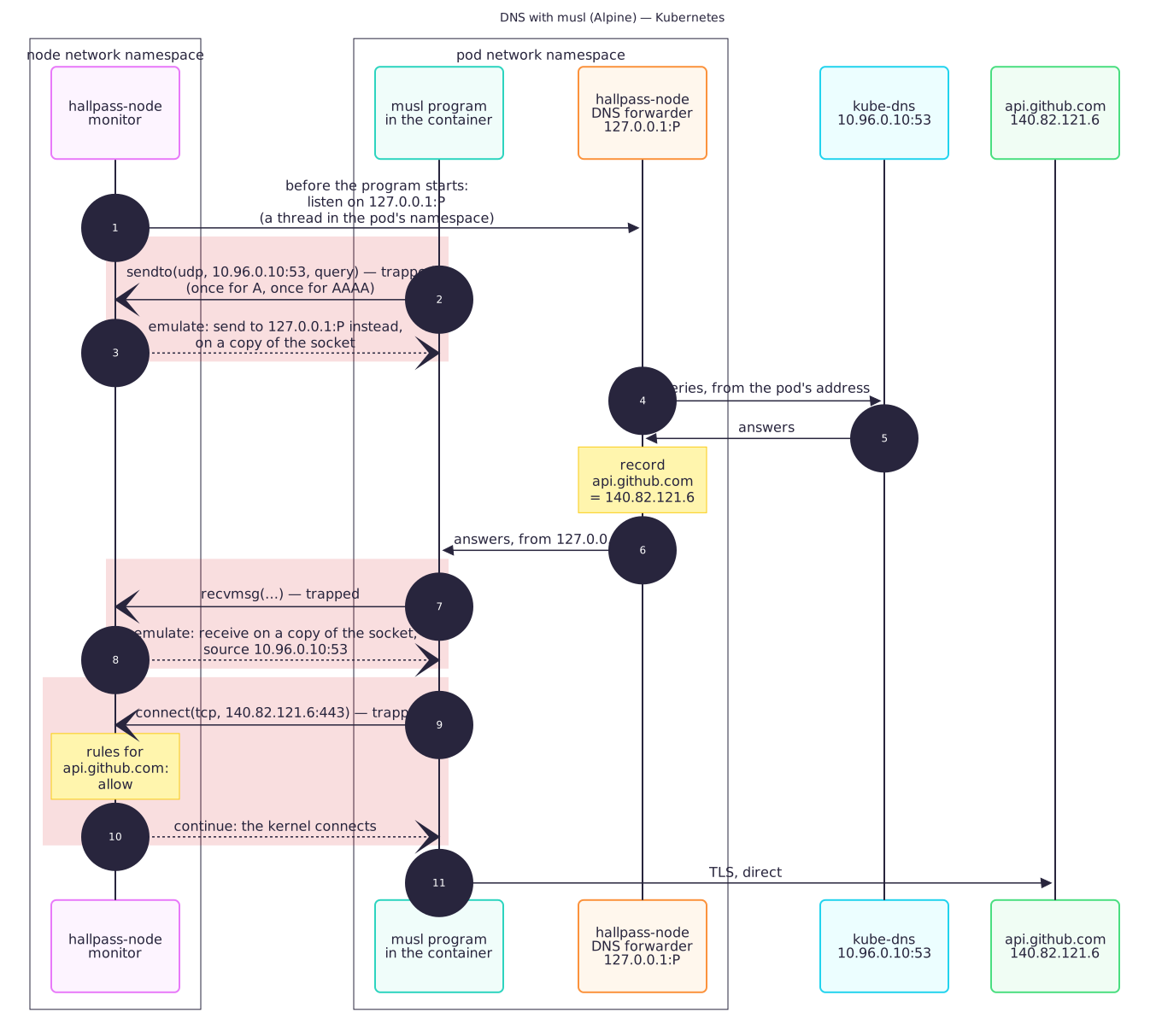
musl does not connect: it sends each query with sendto to the server's address, and reads the answers with recvmsg.
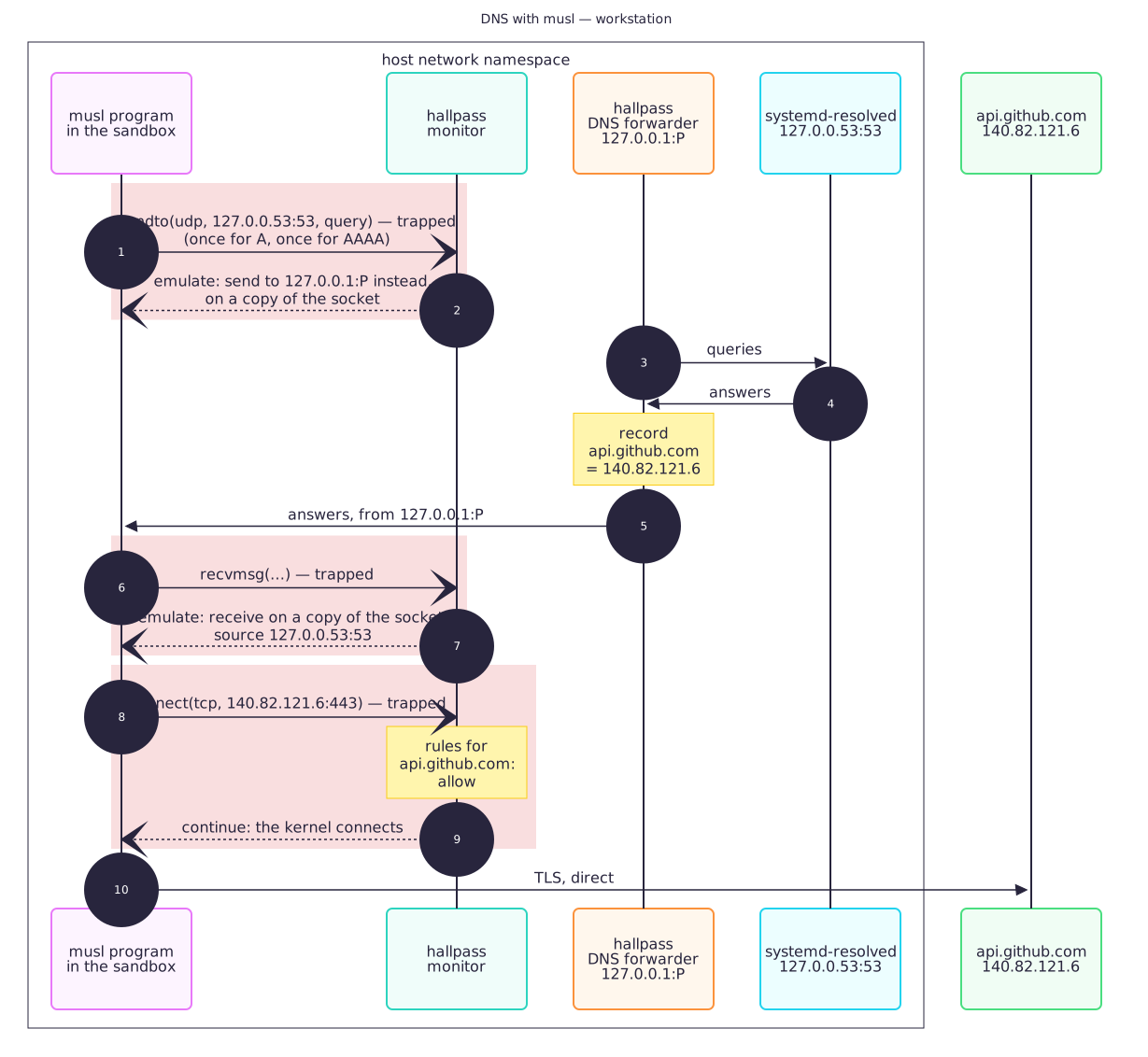
Go with cgo resolves through glibc: on Ubuntu, as in the glibc tab. With resolve in nsswitch.conf (Fedora, Arch), glibc asks systemd-resolved's varlink socket (/run/systemd/resolve/io.systemd.Resolve) instead of port 53. hallpass relays it:
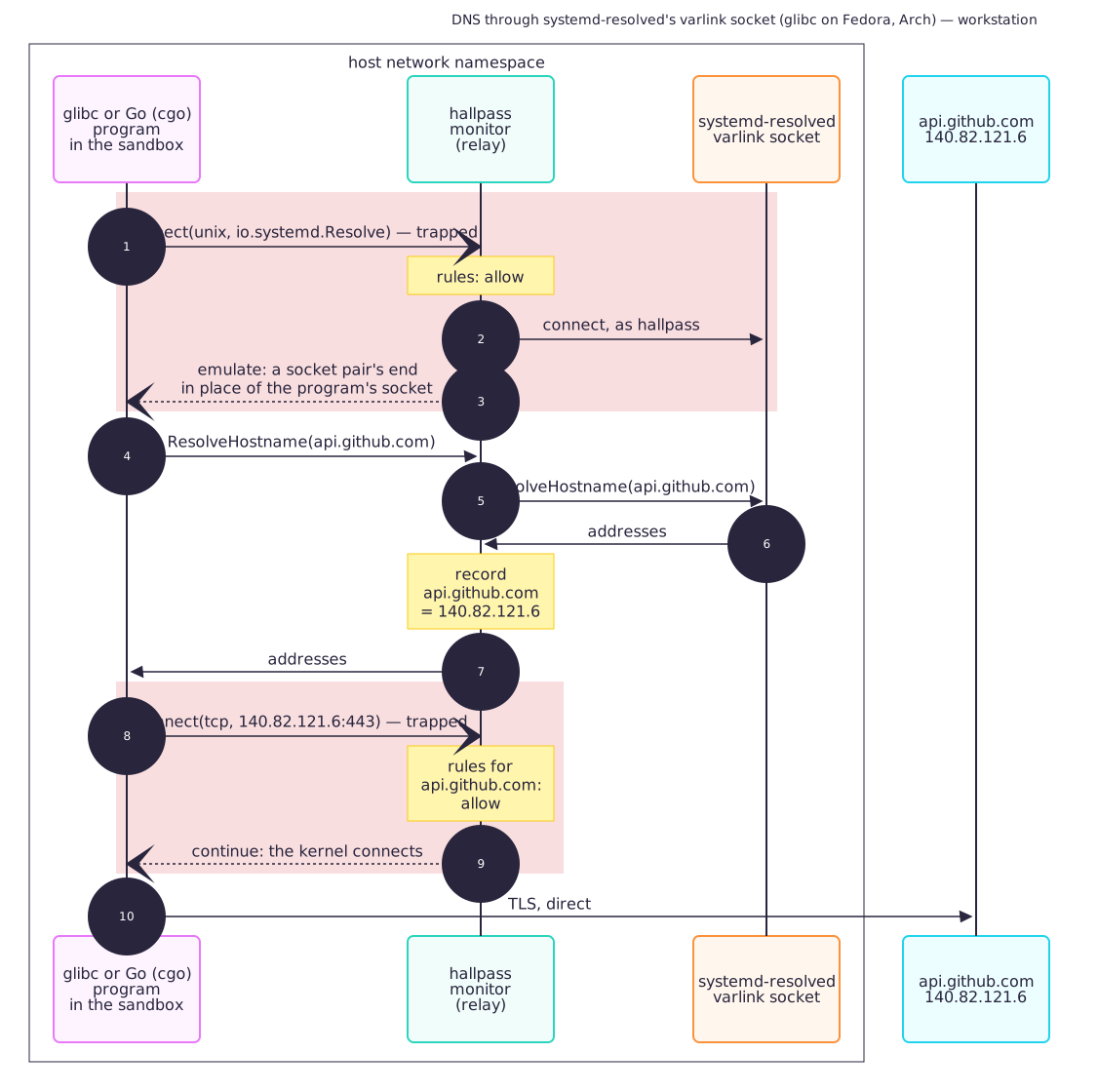
The names come from resolved's own answers, so they are the addresses the program gets. resolved sees hallpass's user, the same as the program's. Only this socket is relayed. Socket options set before the connect are lost, which resolved's clients do not use.
What names match
- The rules see the real name server: a sandbox denied DNS gets no forwarding.
- Names come only from answers the sandbox got through hallpass: an address is named only with a name whose answer had it. A sandbox asking about
github.comand connecting elsewhere gets no name. hallpass sends no query of its own for a name. - The forwarder passes replies on byte for byte. It records only replies that answer a query it sent (same ID and question).
- A name stays on its addresses for 5 minutes, at least: programs keep answers past their TTL.
- An address with no name from the above is shown with the names of its reverse DNS (PTR), marked unverified:
140.82.112.3:443 (reverse DNS, unverified: lb-140-82-112-3-iad.github.com). Whoever controls the address chooses them. hallpass makes that lookup only once the sandbox got an answer through hallpass (the forwarder or the varlink socket), through the host's name servers, so a sandbox denied DNS cannot use it to send data out. - Host rules (
allow connect github.com:443) match these names, in lite and strict mode: the relayed answers, never the reverse DNS names.
Address sorting probes
Once it has the answer, a resolver sorts the addresses of a name (RFC 6724) with a UDP connect to each, sending nothing, to read the source address the kernel picks: glibc to port 0, musl to port 65535, Go to port 53. They are not asked about. Such a connect that no rule decides is done by the supervisor on a copy of the socket, after shutting its sending side:
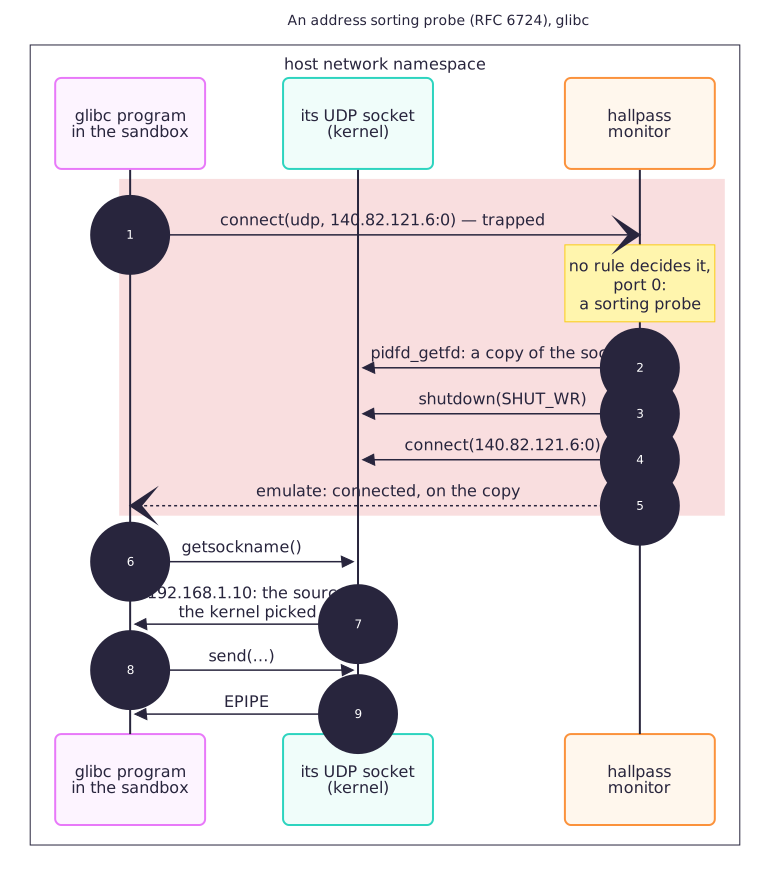
Every send on the socket fails with EPIPE, after another connect too. For port 53, only to an address of the sandbox's DNS answers that is not a name server (so not with --dns=off); other connects to port 53 are asked about. glibc probes the port of the service asked for, if any (curl: 443): that connect is decided by the rules, or asked about. A program that connects a UDP socket to port 0 or 65535 to send gets EPIPE instead of a prompt: a rule allowing the destination lets it through.
Limits
- The forwarder's sockets are made in the sandbox's network namespace: queries leave as the sandbox's would.
- The forwarder's ports are denied to the sandbox (protected rules): it reaches them only through the redirect. They are not denied to other programs of the host, other hallpass sessions included: their queries through it name addresses in this session too (see Limitations).
- Not redirected:
sendmsgandsendmmsgwith the server's address (no resolver sends so), and TCP fast open. Such queries go to the server, and their answers name nothing. - Costs: every
recvmsgof the sandbox, and everyrecvfromwith an address, is paused, to tell whether it is on a redirected socket (see Limitations). A blocking receive on a redirected socket waits in the supervisor: a signal the sandbox catches does not interrupt it (itsSO_RCVTIMEOis kept).getpeernameon a redirected socket gives the forwarder. - hallpass remembers the last 4096 redirected sockets: DNS fails on an older one still in use.
- Needs Linux 5.14 (
SO_NETNS_COOKIE: only the sockets of the sandbox's network namespace are redirected); without it, no names.
Kubernetes
A container that mediates connect has its DNS queries redirected to a forwarder of hallpass-node's, as on a workstation. hallpass-node runs in the node's network namespace, but makes the forwarder's sockets in the pod's, with a thread that joined it: the forwarder listens on the pod's loopback, and queries leave from the pod's address, so NetworkPolicy still applies. There is no varlink relay: the name servers are those of the container's /etc/resolv.conf, usually kube-dns.
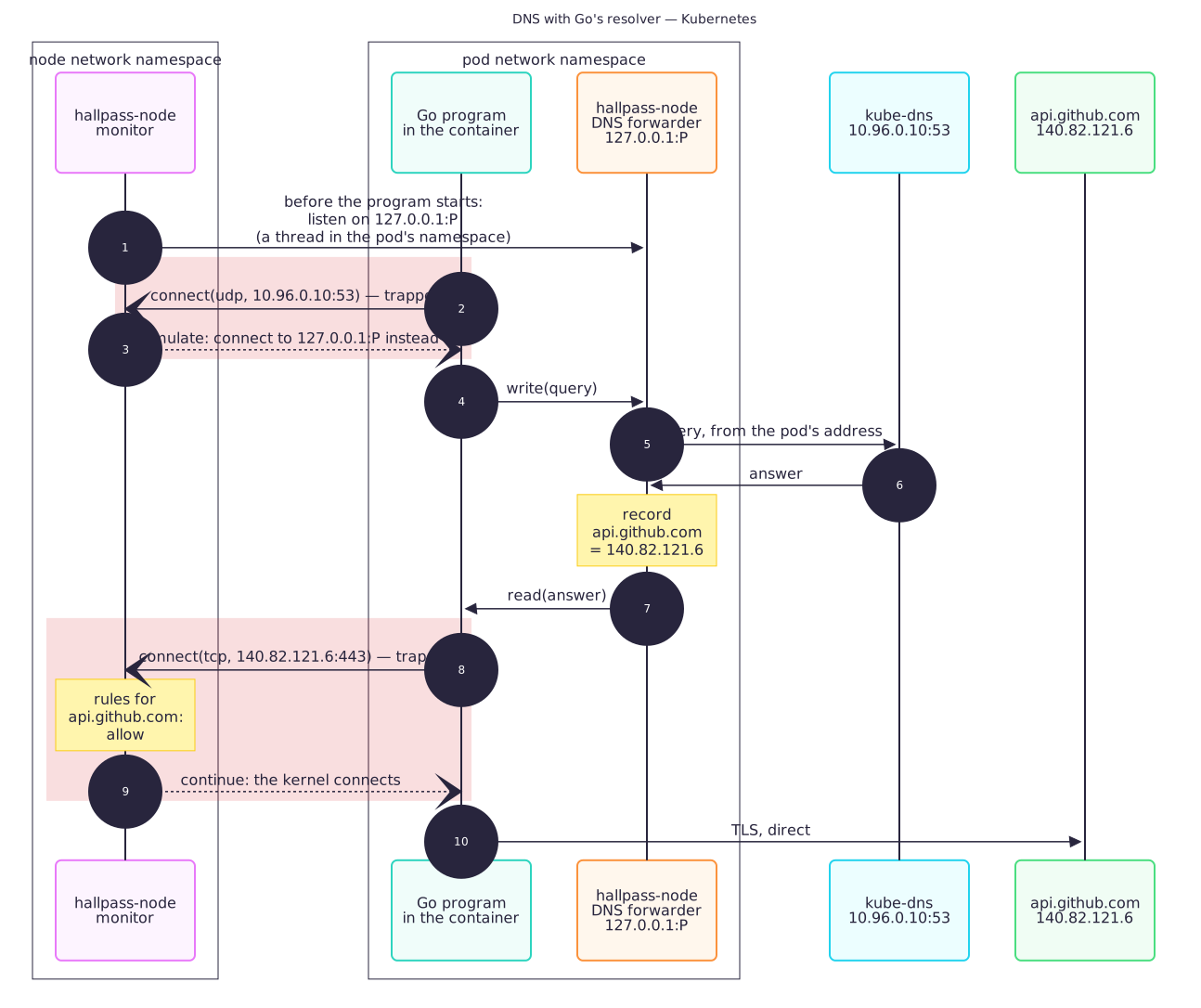
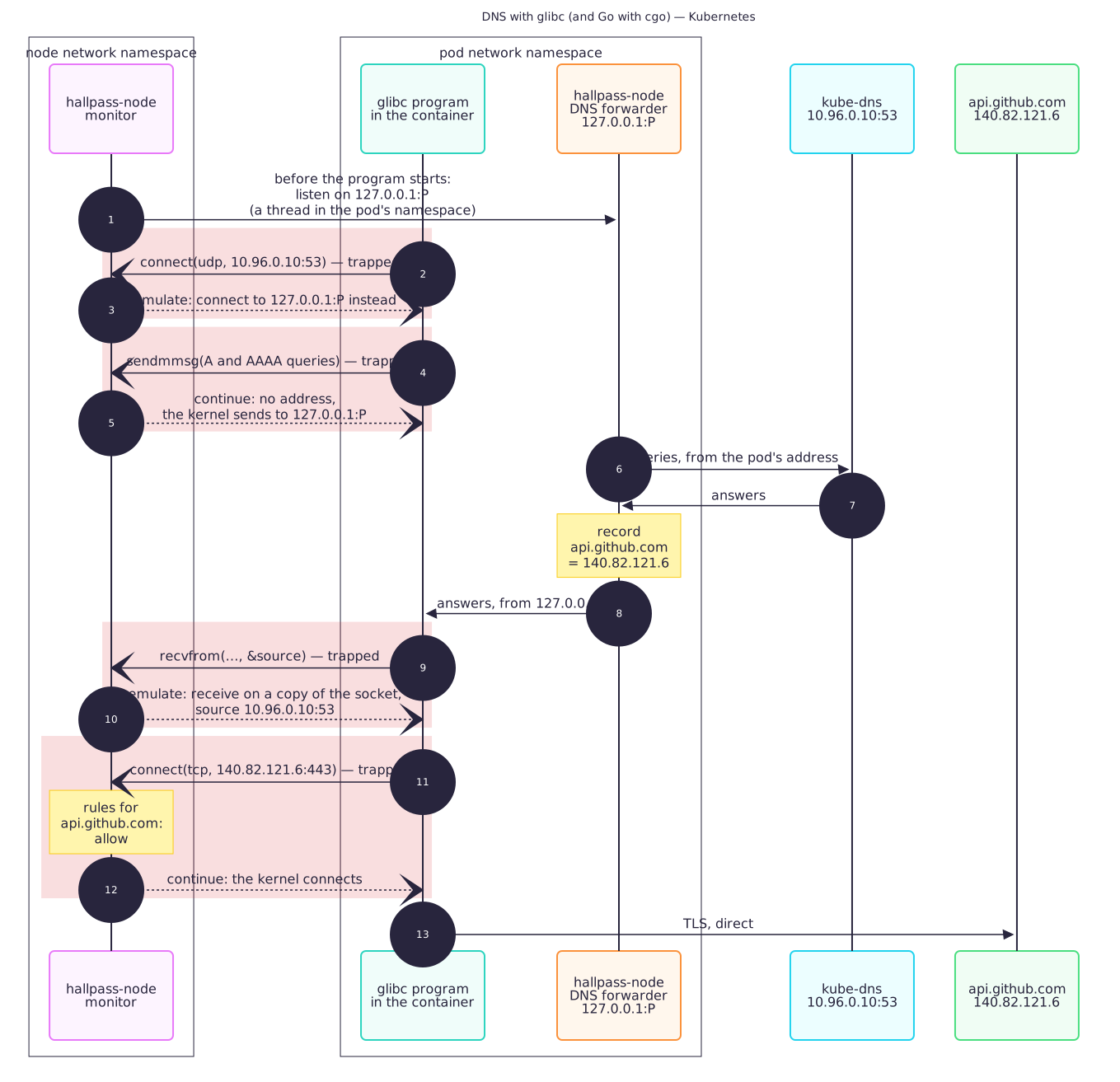
As glibc: there is no varlink relay on Kubernetes.
Differences from a workstation:
- The name servers are those of
/etc/resolv.confwhen the container starts: one the container writes later is not used. - The container is denied its forwarder's ports, and so are the other mediated containers of the same pod (or of the node, with
hostNetwork: true): they share its loopback. - A container restored from the fd-store after hallpass-node restarted has no names.
- The name servers are the container's own, which the pod's author chooses (
dnsConfig): a host rule trusts them. Where pod authors are not trusted, prefer address rules, or the HTTPS proxy, which checks the servers' certificates.
CAP_NET_RAW
A container that may have CAP_NET_RAW can sniff the forwarder's query and forge its reply:
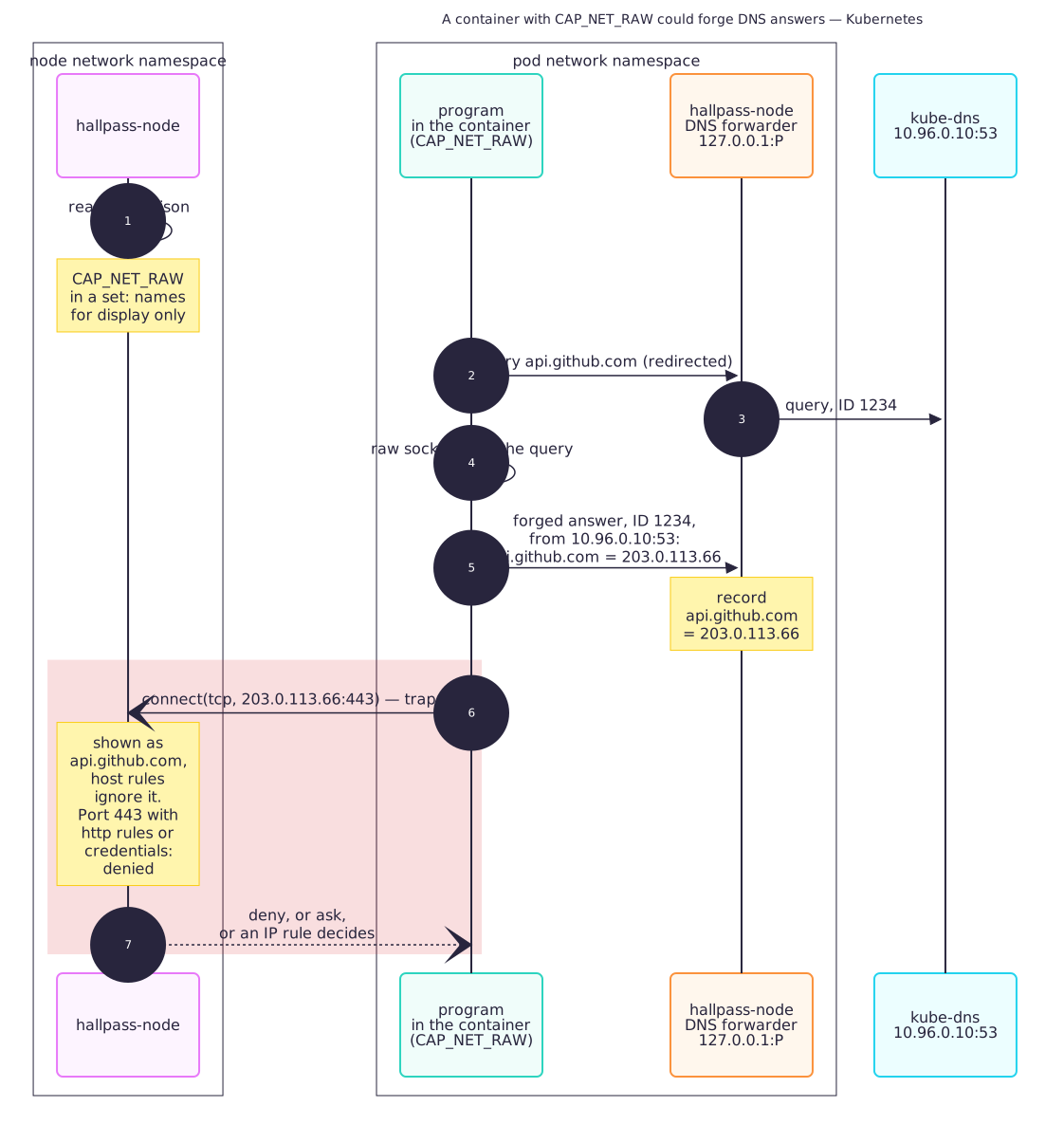
So its names are shown in prompts but never matched by host rules, and with http rules or credentials it is denied port 443 (the started Event says so). hallpass-node reads the capabilities in the container's OCI config (config.json of its bundle, under --host-root): CAP_NET_RAW in any set, containerd's default, or a config it cannot read or without capabilities, counts. Drop NET_RAW from the container's capabilities for host and http rules.